Search Queries Analysis and Adjusting Promotion Strategy
In 2019 we received a request from a potential client to promote an English-language website devoted to "soaking tubs" (deep bathtubs for full immersion in water). We studied the client's online store, then decided to analyze search queries and find out whether the website pages corresponded to it. As it turned out, even for a single query the situation is not quite what the client expected.
We're going to tell you the results of our search queries analysis, frequency, and website structure, and what we proposed to the client for promoting an English-language site in organic Google results.
Search Queries Analysis
SEO begins with an in-depth analysis of your website, advertising, and competitors. One of the most important stages is a study of actual search demand for all selected queries, compilation of a semantic core, and visualization of possible website structure, as well as analysis of existing pages for correspondence to the primary queries. Read up on all available consulting services, including search queries analysis.
Search queries analysis across all regions of the United States
We started by studying search demand across all regions of the United States.
Query: Japanese soaking tubs
USA frequency: 12,100
-
Total tails: 707
-
Total frequency: 35,000
- Queries with a frequency of >0: 204
- Queries with a frequency of 0 (one-time hits): 503
3. Queries with "sale-boosting" keywords (sale, buy, price, etc): 25
- Total frequency: ~500
4. Primary category queries: 2 (Japanese soaking tub / Japanese soaking tubs)
- Frequency: 24,200
5. Estimated number of tails / subcategories: 30+
From the data obtained, we drew two primary conclusions:
- Users are aware of the product: this is indicated by a fairly high frequency of primary queries.
- About a third of users search for the product by additional properties: search demand is not concentrated solely on the two primary queries. Furthermore, the number of additional properties is quite large.
Questions that arose after preliminary analysis of top rankings and search queries:
- Are there synonyms for primary queries?
- Why is demand with sales-boosting keywords not developed, and will it develop in the future?
- How developed are the subcategories (do many such queries have their own tails)?
- How have subcategories behaved in the past and will they develop in the future?
- How well does the current website structure match the search demand structure?
Make Search Query Analysis Now!
Search engine research
An analysis of tails for the query "Japanese soaking tubs" showed that there was a significant set of queries associated with product properties and suitable for both individual products and subcategories, or for parameter selection filters. For example, the following nominal search query groups may be distinguished (Japanese soaking tubs + keyword).
| By size: small (for small spaces, for small home, etc.); 2 person / for two; size (24/30/36/41/46/48/60 inch) | By material: wood / wooden (Japanese soaking tubs wood, Japanese hinoki wood soaking tub, wood fired Japanese soaking tub); acrylic; stone; stainless + steel; copper; etc. | By location: outdoor; (in / for) bathroom; (in / for) shower; etc. |
|---|---|---|
| By installation method: freestanding; portable; etc. | By type: round; ofuro; deep; heated; etc. | By accessories: with seat; etc. |
| By locale: USA; specific states (Utah, etc.); specific cities (NYC, Seattle, etc); also quite often in search results for USA the keyword UK appears |
Synonyms
The query also has meaning-expanding tails, which are essentially synonyms, as well as direct synonyms:
- Japanese STYLE soaking tub (tail of primary query)
- Japanese SITTING tub (synonym)
- Japanese BATH tub
- Japanese soaking BATH
- others are also possible
Almost all of these queries have a frequency of >0 and have their own tails (that is, they are developing).
For example, the query "Japanese soaking tubs wood" has the tail "Japanese soaking tubs wood OUTDOOR" – that is, here two subcategories intersect.
Conclusions:
- Search demand is already fairly developed and, most likely, will develop further.
- Users learn in the process of searching for a product category: this is evidenced by the presence of a large set of category queries and the absence of sales-boosting keywords for them.
- Accordingly, the better the website structure matches the structure of user queries, the greater the website's authority in the eyes of users.
- The presence of synonymous queries shows that some potential buyers will most likely not reach the website if these queries are ignored in the structure of the page's categories, filters, and content.
Questions:
- Which of the above queries are used on the primary category page?
- What elements on the page render it strong for these queries?
- How are other pages of the website optimized based on the structure of actual search demand, and do other pages take these queries into account?
- Which specific pages – product cards, categories, filters, home page, articles – attract thematic traffic for these queries?
Analysis of customer website pages
For the query "Japanese soaking tubs," the primary relevant page of the website was taken: https: //***.com/category/japanese-bathtubs
Dynamics of queries for this page
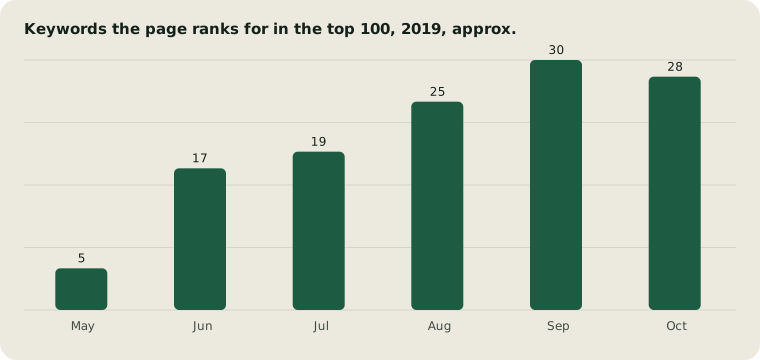
Approximate values read from the rank tracker's keyword chart. One keyword reached the top 3 from August on. The tracker marked a database expansion in June, so part of the May-June jump comes from the tool, not the page.
Current search queries of the page in search results
| Keyword | Position | Search Volume |
|---|---|---|
| japanese style bathtub usa | 3 | 70 |
| buy japanese bath | 7 | 70 |
| plastic ofuro | 8 | 20 |
| japanese bath tubs | 9 | 590 |
| japanese soaking tub drop in bathtub | 10 | 20 |
| japanese tub | 11 | 1900 |
| japanese style tub | 11 | 170 |
| japanese soaking bath | 11 | 110 |
| japanese soaking tubs | 12 | 12100 |
| japanese soaking tub | 12 | 12100 |
| drop in japanese soaking tub | 13 | 110 |
| japanese style soaking tub | 13 | 260 |
| japanese red tub | 14 | 30 |
| japanese square bath | 17 | 30 |
| japanese tub for sale | 17 | 90 |
| metal japanese soaking tub | 19 | 30 |
| japanese soaking bathtubs for sale | 20 | 20 |
| japanese ofuro bath uk | 21 | 90 |
| buy japanese bathtub | 22 | 30 |
| outdoor japanese soaking tubs | 22 | 480 |
| japanese plunge bath uk | 24 | 70 |
| japanese style shower and bath | 25 | 20 |
| japanese style bath | 32 | 480 |
| wooden soaking tub kit | 36 | 70 |
| cedar japanese soaking tub | 40 | 50 |
| ofuro cover | 60 | 20 |
| japanese bath | 74 | 4400 |
| cedar ofuro | 79 | 20 |
As we see, the page appears in Google search results for 28 queries. At the same time, for the US only 5 of these are in the top 10, 12 more queries are in the top 20, and 11 queries (40%) are out of user reach.
This means that the page is thematically relevant and well-rated by the search engine. But the structure of search queries for the page does not match the structure of the actual search demand described above.
First of all, the page is in the top rankings for synonymous queries with sales-boosting and localizing keywords:
- japanese BATH BUY
- japanese BATH soaking
- japanese BATH tubs
- japanese STYLE tub
- japanese STYLE BATHTUB USA
- japanese STYLE soaking tub
- japanese tub
- japanese tub FOR SALE
- japanese soaking BATHTUBS FOR SALE
The page can collect partial traffic for queries that describe properties, but these also more likely refer to tails of synonym queries (that is, they do not include the words "soaking" or "tub"):
- japanese RED tub (by color, no "soaking");
- Japanese SQUARE bath (by form, no "soaking," no "tub" — synonym tail);
- PLASTIC ofuro (by material, pure synonym, no entry for "Japanese soaking tub" whatsoever);
- METAL Japanese soaking tub (by material, pure subcategory tail).
The two primary search queries are also identified as relevant and rank fairly highly, but it is apparent that they can be strengthened.
At the same time, judging by the names of the products, the product pages are collecting only partial thematic traffic. A selective analysis of product cards showed that the product pages are actually optimized as category pages. But they contain a number of significant errors that prevent the pages from being relevant to the primary queries.
We also noticed that the filter names do not match the current queries and do not show the full set of searched-for properties. We also found a filter generation error that prevents a large number of thematic pages from participating in the search.
Semantic core for the English-language website: SEO promotion proposal for the client
Having reached the conclusion that localization (the degree of local markers) is insignificant for the given niche and cannot yet be taken into account, here is the plan of action that we proposed to the client.
-
Evaluate the actual search demand for all selected queries, compose a semantic core, and visualize a possible structure.
-
Evaluate the capabilities of current website pages in accordance with the selected queries.
-
Evaluate the structure of competitors' search queries:
- visual overview of search results for the semantic core;
- evaluation of competitor website performance;
- comparison of competition levels for the main pages;
- assessment of competitor web page relevance for selected queries (resulting in their top rankings).
-
Conduct a technical audit of the site to identify problems that hinder SEO-promotion of an English-language website, and prepare terms of reference for revision of meta tags, filters, product cards, categories, other types of pages, and internal linking.
-
Clarify the overall promotion strategy.
-
Prepare a link-building strategy.
-
Prepare terms of reference for informational articles on queries isolated from the main semantic core for each category.
Results
The client appreciated the audit performed, but decided not to implement our proposed strategy. As we gathered, the scale and scope of the work was greater than the client anticipated.
"Indeed, investing in SEO is a marathon, not a sprint, and does not yield instant results. As a short-term solution you can use other promotion methods, such as contextual advertising. But for optimal results we recommend combining promotion tools selected based on your initial positions and the desired outcome."
search engine marketing analyst at Onlinuum
Originally published on the Alconost Digital blog. Onlinuum is run by the former Alconost Digital team.

